


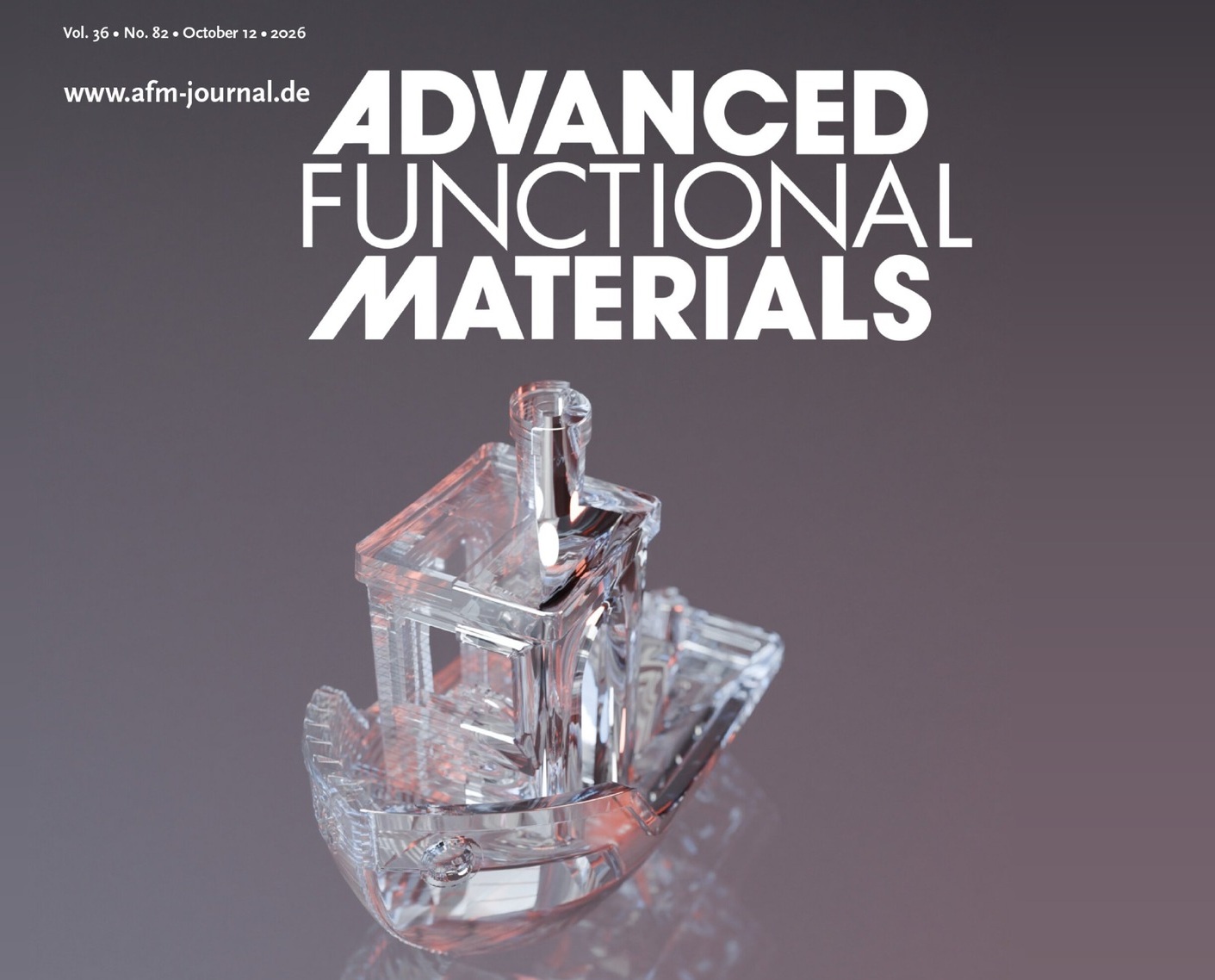
Glass microstructures on the cover of Advanced Functional Materials
A Cluster research article first published in July 2026 has now been featured as an Inside Front Cover in Advanced Functional Materials. The underlying work was conducted by Doctoral Researchers Jonathan Schneider and Jiajie Liang, Postdoctoral Researcher Paul Somers, and Principal Investigators Martin Wegener and Jens Bauer.
The study introduces a route for two-photon grayscale lithography of silica glass microstructures. By continuously adjusting the printed feature size during fabrication, the team can create complex 3D glass architectures with smooth contours, high accuracy, and improved throughput.
The resulting structures combine the design freedom of 3D laser printing with the advantages of glass as a material. The researchers demonstrate low-loss mechanical microresonators, microlenses with optical-grade surface quality, and nanoscale diffractive patterns for holographic optics.
This opens promising pathways for photonics, precision mechanics, and metamaterials, where robust, transparent, and mechanically high-quality microstructures are essential. The work also provides a practical framework for extending grayscale 3D printing to further custom materials.
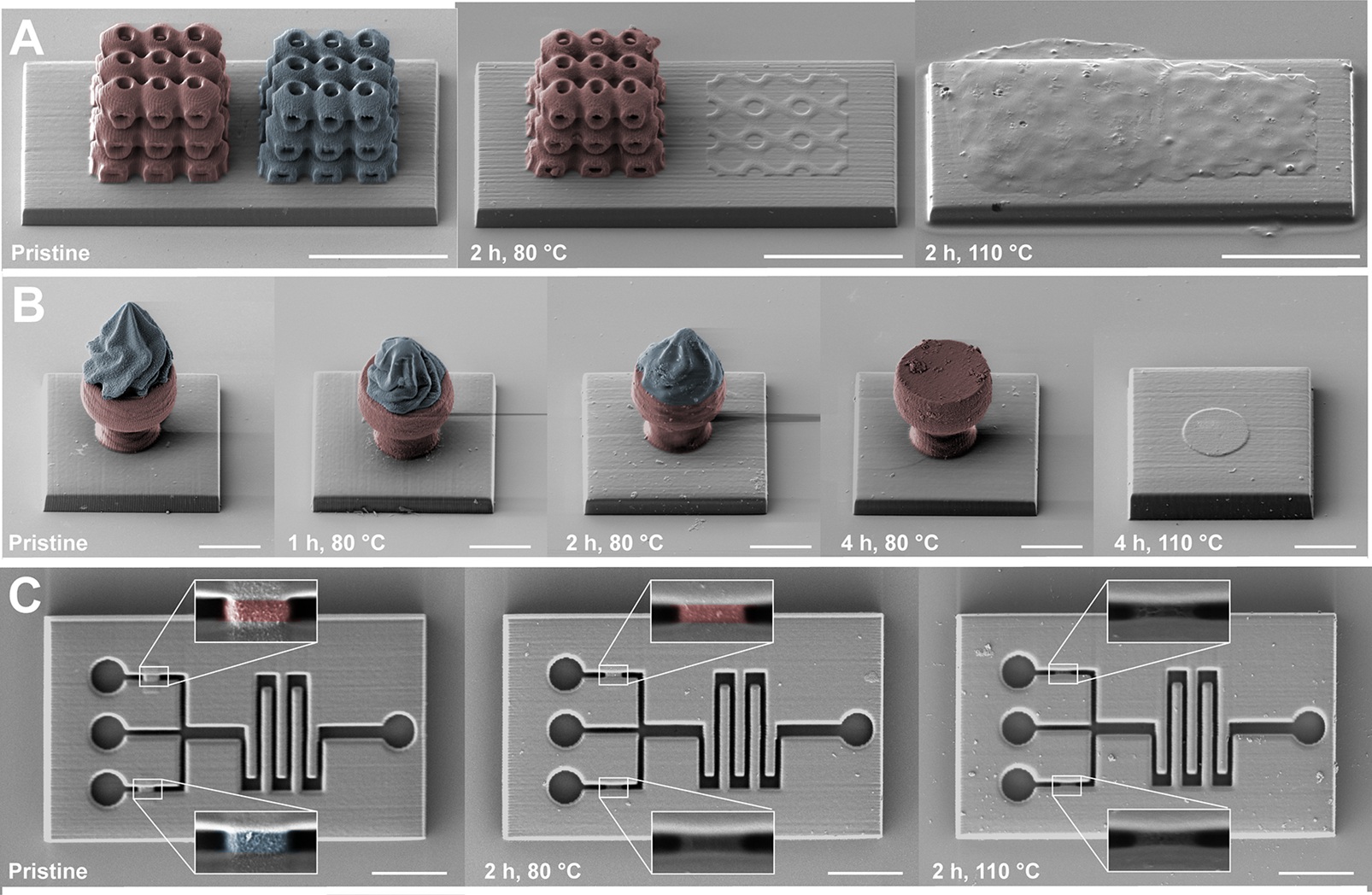
Two Isomers, Two Temperatures: Programming the Degradation of 3D-Printed Microstructures
A new Cluster publication in the Journal of the American Chemical Society shows how tiny 3D-printed structures can be designed to dissolve step by step, simply by heating them. Postdoctoral Researcher Florian Feist and Principal Investigators Martin Wegener and Christopher Barner-Kowollik, together with colleagues at Queensland University of Technology (QUT), use two versions of the same molecular connector that holds the printed material together.
Both versions consist of identical atoms, but their parts are arranged differently in space. As a result, they come apart at different temperatures. The team printed microstructures from both variants, including a tiny soft-serve ice cream cone and a microfluidic chip with valves. At 80 °C, the parts made with the first variant dissolve, while the others stay intact. Only at 110 °C do these break down as well. This way, a material’s behavior can be programmed through the shape of a single molecule, opening up new possibilities such as valves that open one after another in response to temperature.
© Fanelli, Gauci, Kim, Foster, Micallef, Wang, Feist, Wegener, Frisch, Barner-Kowollik, Journal of the American Chemical Society (2026)
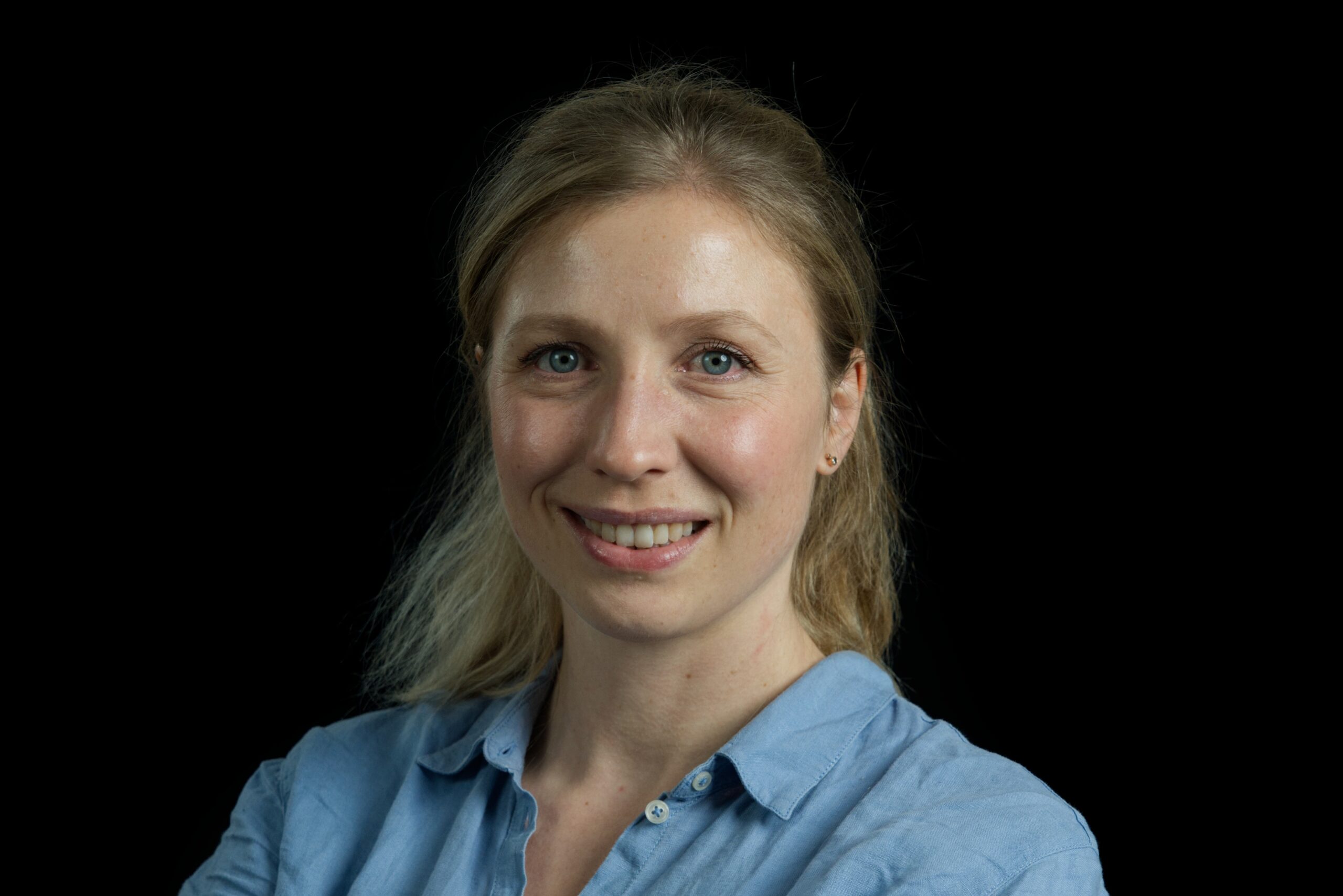
Yolita Eggeler appointed W3 Professor and Director of LEM at KIT
Cluster Principal Investigator Yolita Eggeler has been appointed W3 Professor of Electron Microscopy and Director of the Laboratory for Electron Microscopy (LEM) at Karlsruhe Institute of Technology (KIT).
Yolita Eggeler joined KIT as a W1 tenure-track professor of electron microscopy in October 2020 and has been a Principal Investigator in the Cluster since then. In January 2024, she became Acting Director of LEM.
Her new position, which she took up on October 1, marks the next step in her academic career at KIT. The Cluster warmly congratulates Yolita Eggeler on her appointment and wishes her every success in her new role.
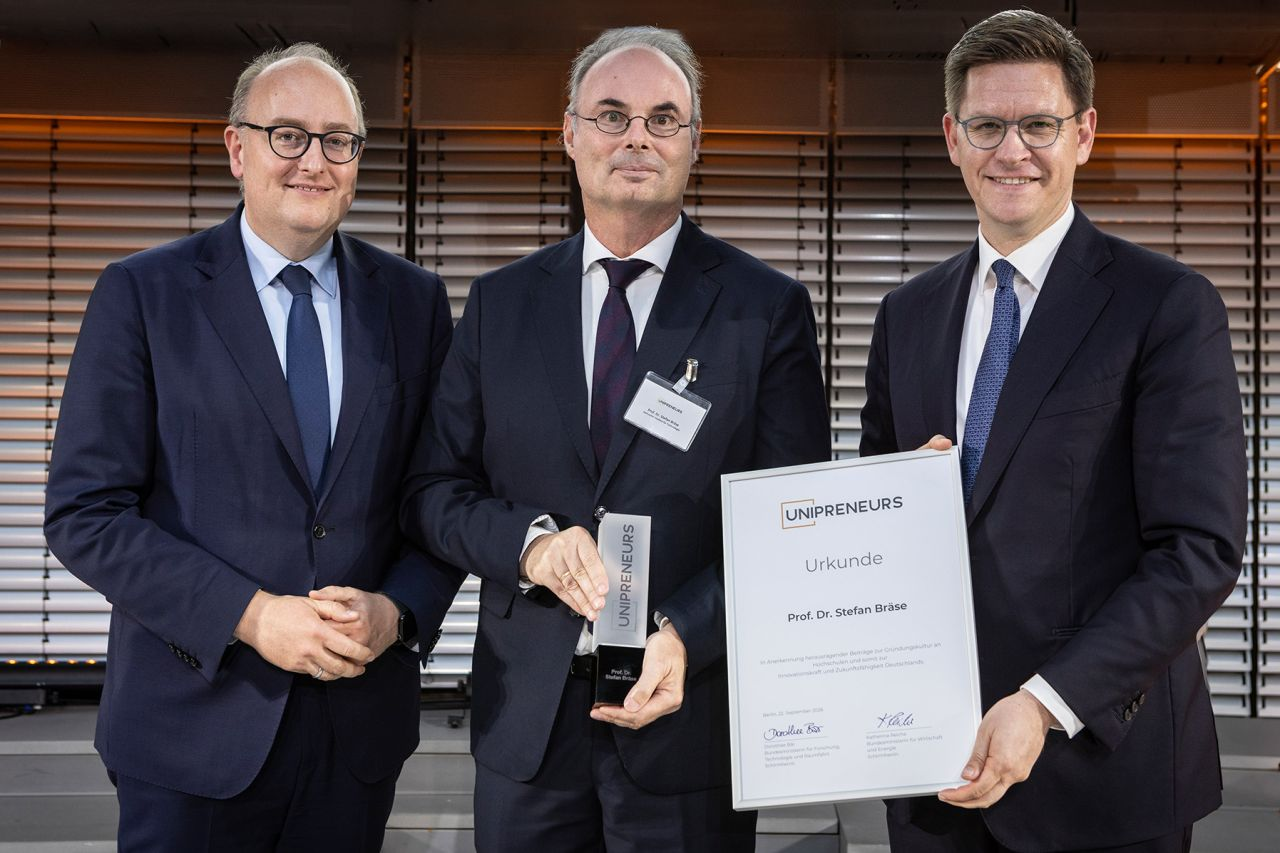
Stefan Bräse Receives UNIPRENEURS Award
Cluster Principal Investigator Stefan Bräse was honored with one of the 20 UNIPRENEURS Awards in Berlin on September 22. The award recognizes university professors who combine scientific excellence with an entrepreneurial spirit.
UNIPRENEURS is a joint initiative of Matthias Hilpert and the Stifterverband and is regarded as Germany’s highest honor for entrepreneurship at universities. The award was presented by Matthias Hauer, Parliamentary State Secretary at the Federal Ministry of Research, Technology and Space (BMFTR), and Johannes Steiniger, Parliamentary State Secretary at the Federal Ministry for Economic Affairs and Energy (BMWE). Awardees were selected from more than 800 nominations.
For Stefan Bräse, supporting young researchers on their path from academia into entrepreneurship is one of the most rewarding aspects of his work as a professor. Entrepreneurship in academia, he said, is not about choosing between science and business, but about creating an environment where excellent science can generate new ideas, technologies, and companies.
The Cluster extends its warmest congratulations to Stefan Bräse on this award.
Ultrafast laser pulses enable thenext generation of nanoscale3D additive manufacturing
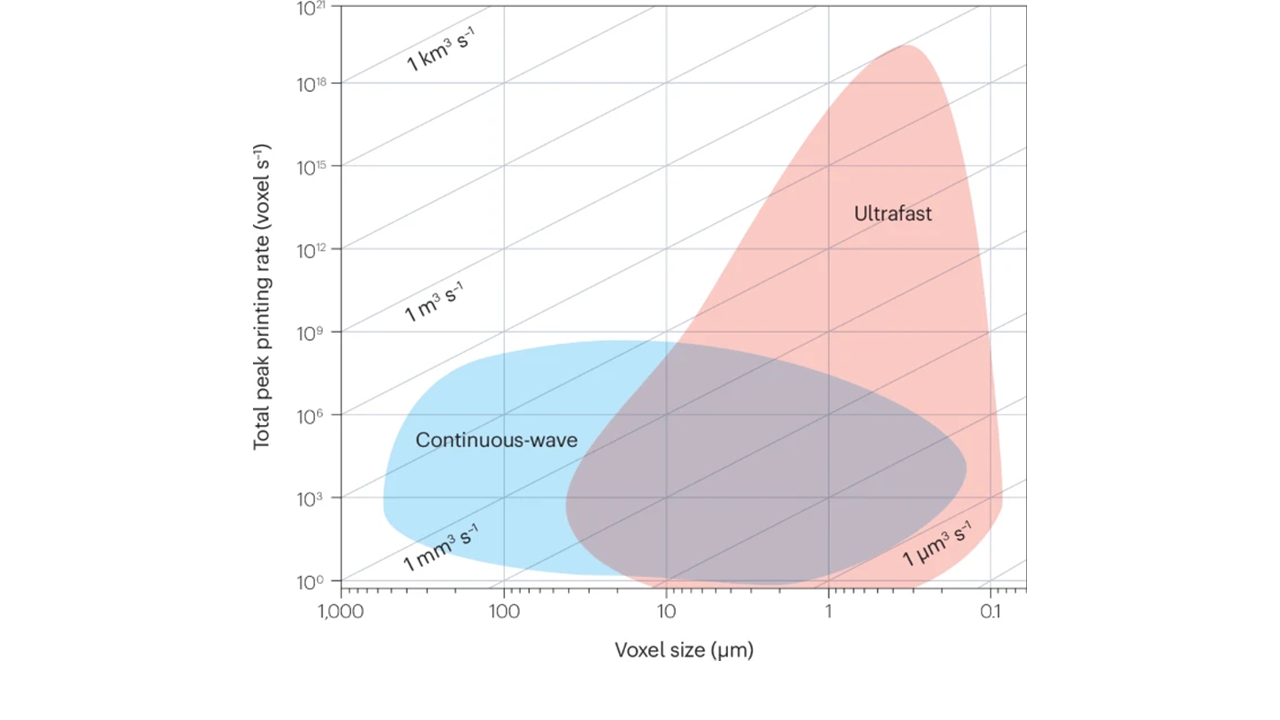
A new Cluster article in Nature Reviews Methods Primers examines how ultrafast laser pulses can advance nanoscale 3D additive manufacturing. Postdoctoral Researcher Paul Somers and Principal Investigator Martin Wegener describe how shaped light pulses could increase the speed and resolution of light based 3D printing.
Conventional multiphoton 3D lithography creates structures by mechanically scanning a focused laser beam through a photosensitive resin. The authors discuss approaches that enable faster printing. Diffractive optical elements can split a laser pulse into multiple focal points for parallel printing. Spatiotemporal focusing can expose an entire two dimensional layer within picoseconds. Holographic techniques can further create three dimensional light patterns, potentially exposing a complete structure with a single ultrafast laser pulse. These approaches could make nanoscale 3D printing more practical for applications requiring submicrometre features and high throughput.
© Somers & Wegener, Nature Reviews Methods Primers (2026), CC BY 4.0
What makes your smartphone light up? The magic behind OLEDs
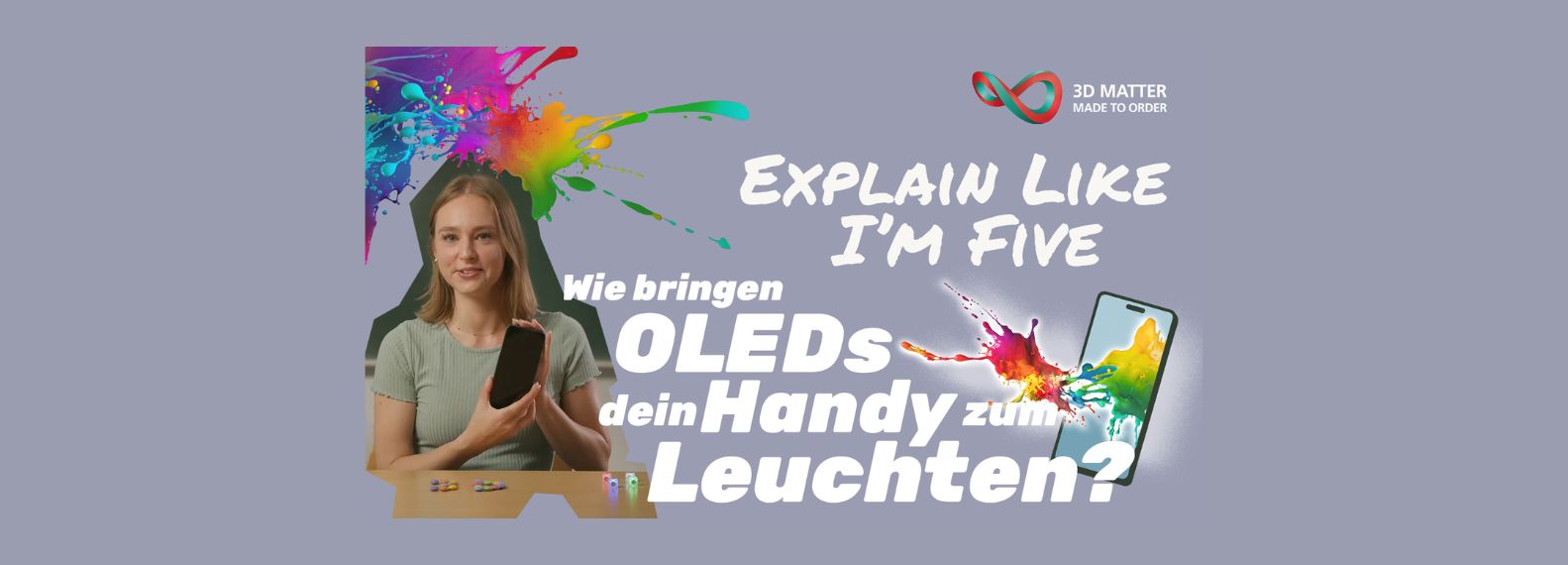
What do molecules have to do with your smartphone display? Quite a lot. Organic light-emitting diodes (OLEDs) enable the bright and vibrant images we see every day.
In the latest episode of our “Explain Like I’m Five” series, Lisa Janz, Cluster Doctoral Researcher at Karlsruhe Institute of Technology (KIT), explains how OLEDs work and why molecular design is key to their performance. She shows how organic molecules convert electrical energy into light and why blue emitters are particularly challenging. Their higher energy makes them more prone to degradation. In her research, Lisa develops new luminescent molecules for OLEDs, using computational methods and advanced 3D printing techniques to integrate promising materials into devices. Her goal is more energy-efficient, durable displays with brilliant colors.
Watch the video here.